
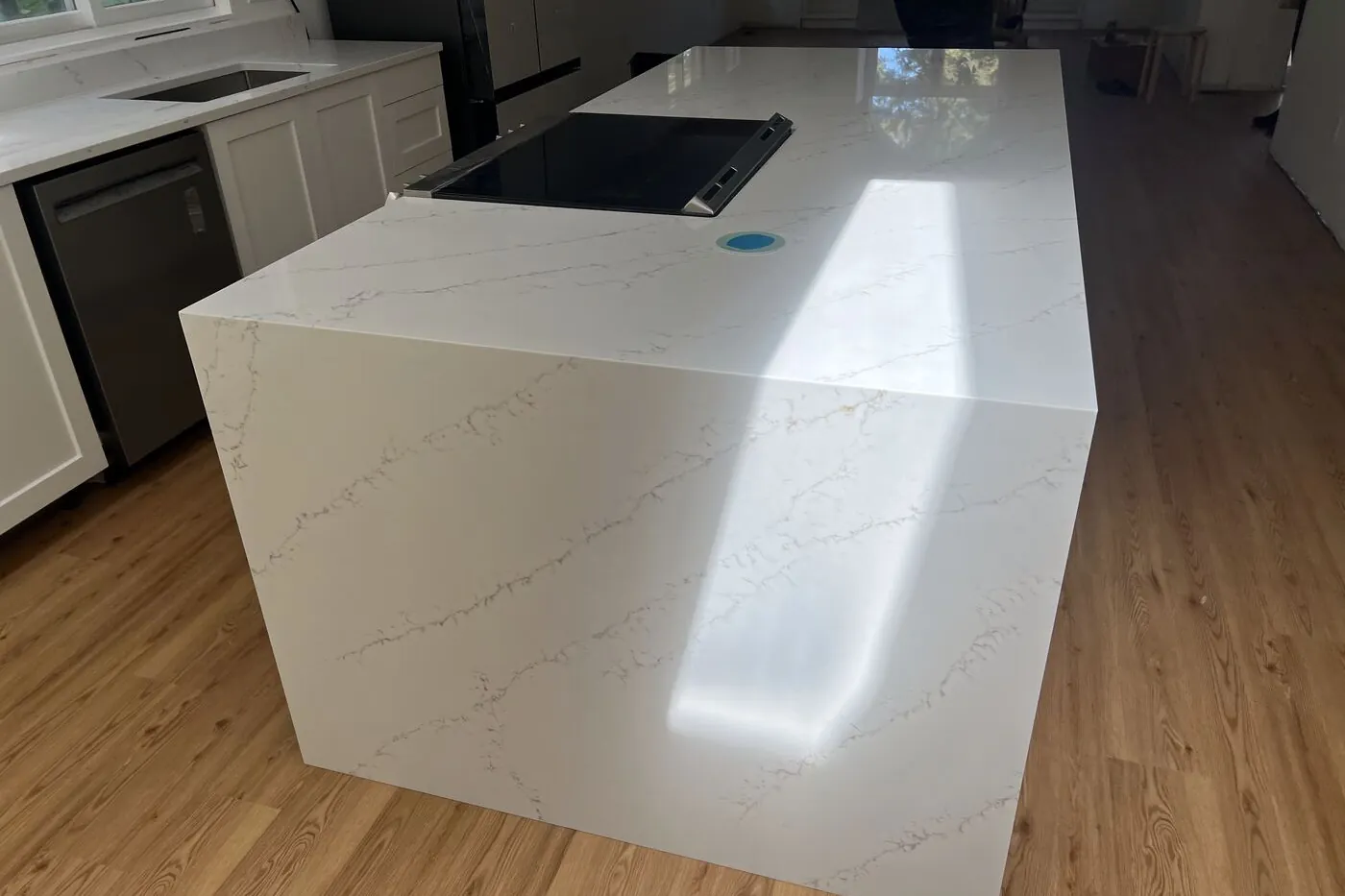
Quartz countertops need no sealing, shrug off wine and oil, and come in a color you can match a year from now. They also scorch under a hot pan and cannot hide a joint the way a busy granite can.
What quartz actually is
Ground natural quartz mixed with resin and pigment, pressed and cured into a slab. That is why the color is consistent from box to box, why it never needs sealing, and why the resin decides its two weaknesses: heat and sunlight.
It is not the same rock as quartzite. Quartzite is quarried. Quartz is manufactured.
What quartz countertops cost here
Quartz slabs run from $ to $$$ on the tier scale we use for every stone. That scale is explained once, on the pricing page.
The tier is the slab, which is half of what you pay. The other half is the work, and it always includes the template, the sink cutout, an eased or quarter round edge, delivery, install and hauling away your old counters. A mitered or ogee edge, a cooktop cutout, a seating overhang that needs steel and plumbing reconnection all add to it. Each one is named on the pricing page and lands on your written quote before you sign, never after.
Where a job sits inside that spread comes down to the collection you pick, not to us. A plain white sits at the bottom. A thick-veined marble-look Cambria sits at the top.
See how the price is built, and what can add to it
Brands and colors we cut
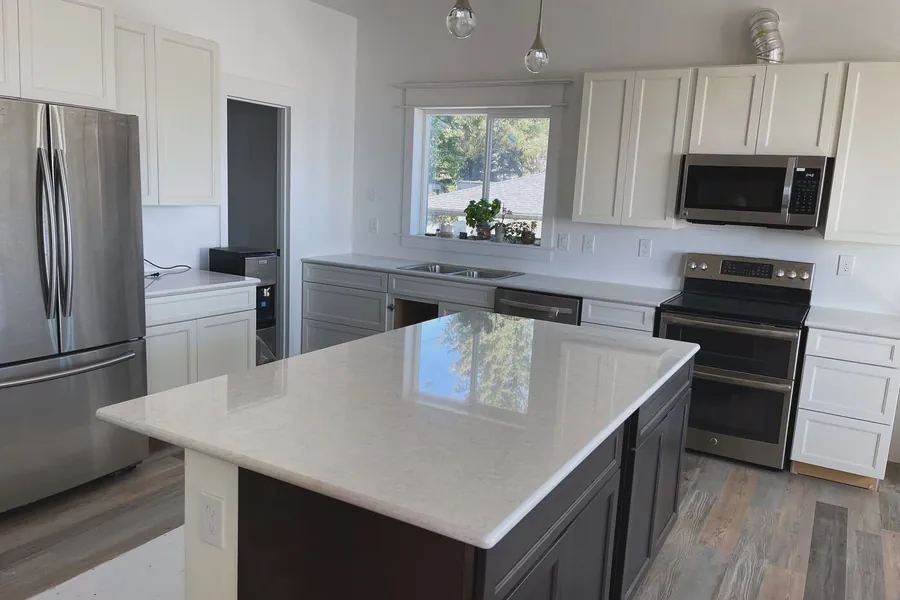
- Cambria ($$$) — Brittanicca, Skara Brae, Smithfield, Kendal. Made in the United States, the heaviest veining, and the top of the quartz range.
- Caesarstone ($ to $$) — the widest range of quiet, plain colors. The safe pick for a kitchen you want to feel calm.
- Silestone ($$) — Miami White, Ariel. Strong whites and grays.
- MSI Q Quartz ($$) — Calacatta Laza, Miraggio Gold. The most-asked-for marble-look, one tier below Cambria.
- PentalQuartz, HanStone (Strato), Vadara, Daltile ONE Quartz ($ to $$) — good slabs that cost less than the two big names for a similar look.
If you have a slab standing at a yard we do not usually buy from, we will go and get it.
What is the downside to quartz
Four of them, plainly.
- Heat. A pan straight off the burner can leave a mark that does not come out. Use a trivet. Granite and quartzite do not care.
- Sun. Years of direct sunlight can yellow the resin, which is why we will not fabricate quartz for an outdoor kitchen.
- Seams. A plain or lightly veined quartz gives a seam nowhere to hide.
- Repairs. A chip in a stone can be filled and polished back. A chip in quartz is filled with color-matched resin, and in the wrong light you will know where it is.
If any of those four is a deal breaker for your kitchen, say so at the measure and we will show you granite or quartzite instead.
Seams in quartz countertops
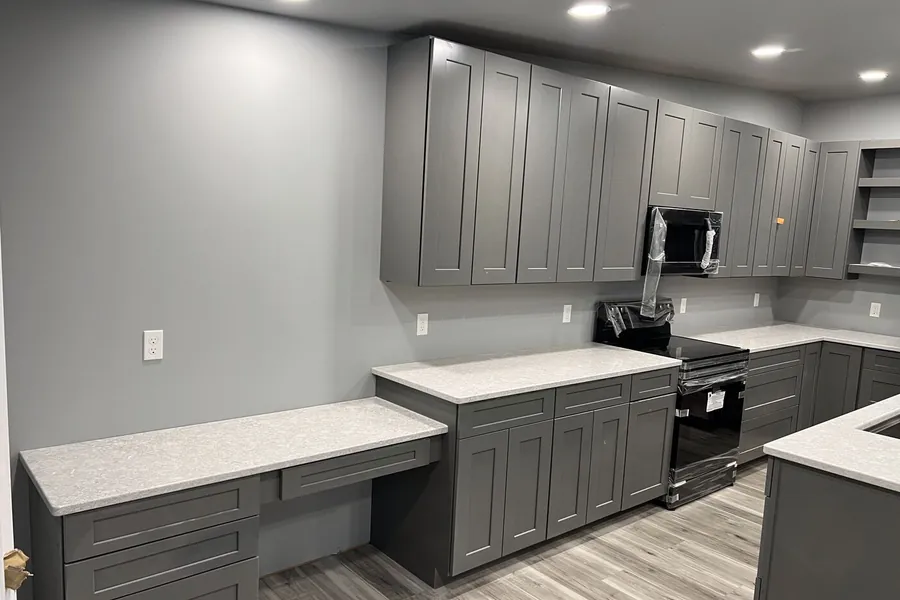
A homeowner on a forum put it in one line: seams are always visible in quartz countertops. She is right, and any shop that tells you otherwise is setting you up to be disappointed on install day.
What is actually in our control is where the seam sits, how wide it is, and whether it is flat. So:
- You see it before we cut. We send a seam layout drawing after the template, showing exactly where each piece breaks and which way the veining runs. Nothing goes on the saw until you say yes in writing.
- We do not put a seam in the middle of the run in front of the window. We put it where a break is natural, and we tell you why.
- It is filled with color-matched filler and it is flat. Run your hand over it at the walkthrough. If you can feel a lip, we fix it before we leave, not on a return visit.
- Veined slabs get sequenced. If your kitchen takes two slabs, we buy them from the same block and lay them out so the vein carries across.
See how the template, the seam drawing and the install day actually go
2cm or 3cm, and which edge
We default to 3cm in kitchens. It sits straight on the cabinets, it holds an undermount sink without extra bracing, and the edge looks like stone rather than tile.
2cm belongs on a bathroom vanity, or in a kitchen where you want a thicker look than 3cm gives, in which case we miter two pieces together to build the edge up.
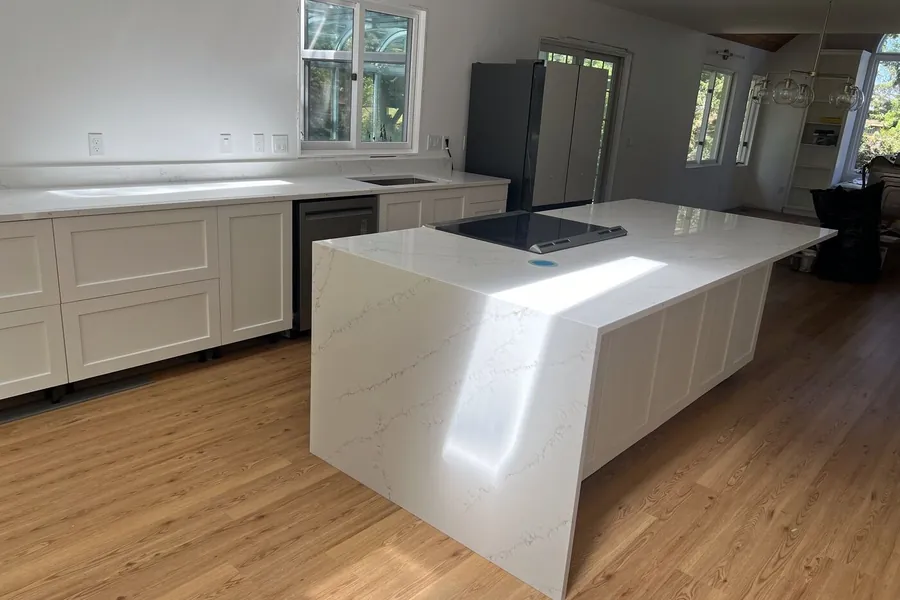
Edges we cut: eased, quarter round, half bullnose, full bullnose, bevel, ogee, mitered and waterfall. Eased and quarter round are in every quote; the rest add to it.
Looking after it
Warm water, dish soap, a cloth. That is the whole routine. Quartz countertops never need sealing.
Do not use vinegar, lemon, bleach, oven cleaner, or any scouring cream. They attack the resin, not the stone, and they dull the surface permanently. Most quartz warranties are void the day you use a harsh cleaner, so keep the bottle of glass cleaner away from it too.
Questions people ask about quartz
How much should a new quartz countertop cost?
It depends on which tier your slab sits in and how many slabs your layout needs, so we name the tier at the measure rather than print a rate here. Quartz runs from $ to $$$, and that is a wide gap for one material. Published market averages, from named third parties, are collected in our cost guide.
What is the downside to quartz?
Heat, direct sun, visible seams in plain colors, and repairs that never disappear completely. The full version is in the section above.
What does vinegar do to quartz?
Vinegar is acidic. Used once it does nothing you will notice. Used as your regular cleaner it eats the resin binder, leaves a dull patch that will not polish out, and gives the manufacturer a reason to refuse a warranty claim. Soap and water instead.
Who has the best deals on quartz countertops?
The cheapest square-foot price usually belongs to a prefab: a pre-cut slab with the edge already on it. It is genuinely cheaper and it is fine in a rental or a laundry room. In a kitchen with an island you pay for it in seams. Ask any shop quoting a low number whether it is prefab or a full slab.
What is the difference between quartz and quartzite?
Quartz is made in a factory and never needs sealing. Quartzite is quarried, is harder, takes a hot pan, and does need sealing. The names are close, the stones are not.
How long does countertop installation take?
Tear-out and install usually happen on the same day for a normal kitchen. The wait sits between the laser template and install day, and it depends on two things: whether your slab is in stock or has to be ordered, and what is already booked in the shop. You get your install date at the template visit, before a single cut is made — not a guess on the phone, an actual date.
Your next step
You know the stone. Now the money and the calendar.
See how a countertop price is built · See how the job runs, day by day · See finished kitchens in quartz
Book a free measure. Tell us the room and the collection you are leaning towards. We measure, and you get an itemized bid by email that you can take to two other shops and compare line by line.
Call (206) 643-9354 or tel:+12066439354 · 18856 72nd Ave S, Kent, WA 98032 · Monday–Saturday, 8:00 – 5:00