
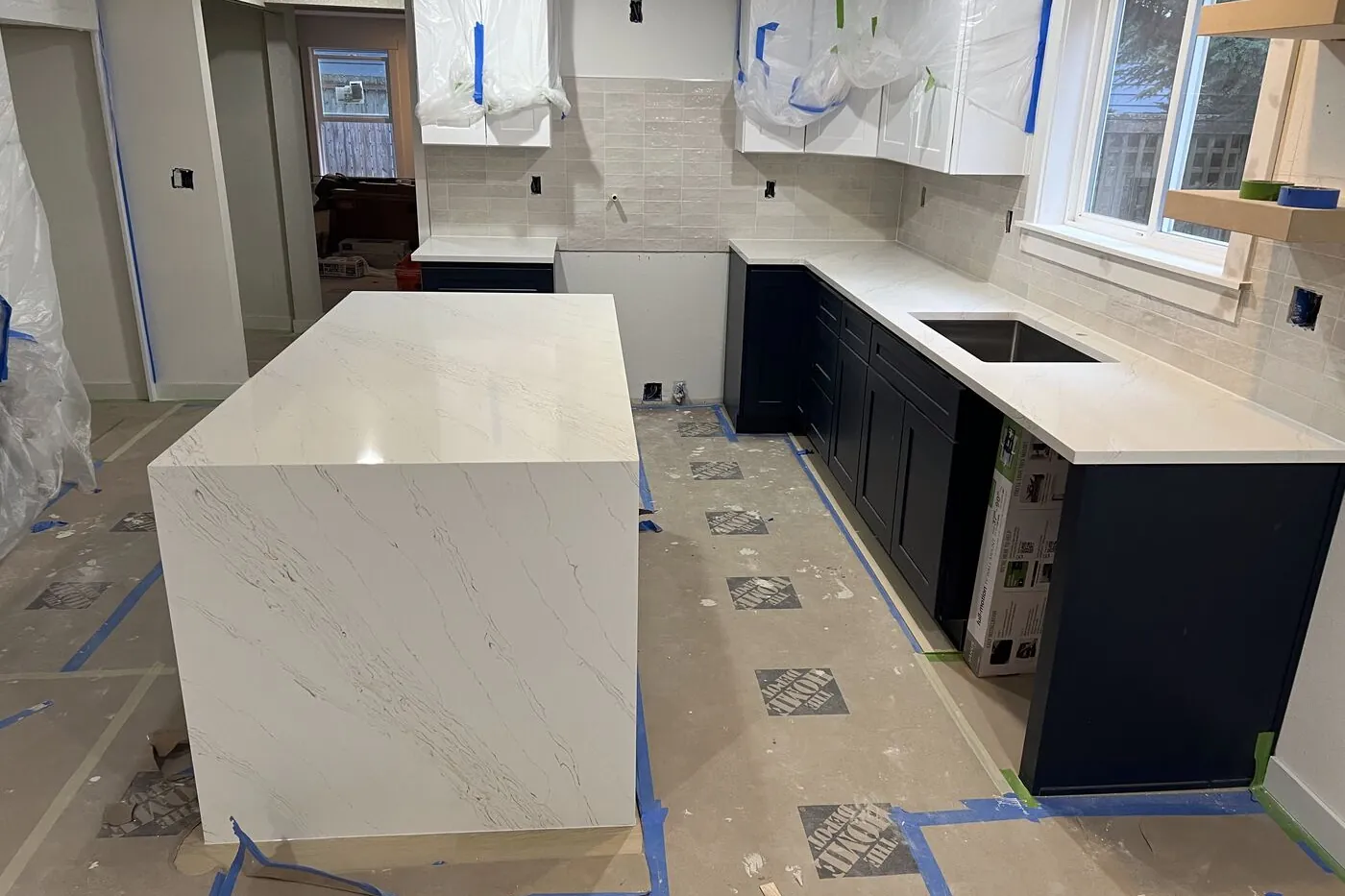
So we answer that first, then show you how a countertop cost per square foot is actually built in this shop — the two halves it comes in, which tier your slab sits in, what is always included, and what can be added.
Book a free measure · See how install day works
The price on your quote is the price on your invoice
Most people in this trade call that document a bid. It is the same piece of paper we call a quote, and there are exactly two things that can move the figure on it.
- You ask for something different. A different slab, a waterfall you decided you want, a second sink. We write the change, we price it, you approve the new figure, and only then do we order or cut. Nothing gets built on a verbal yes.
- We tear out the old top and find damage underneath. Water damage in a sink cabinet is the usual one. We stop, photograph it, and send you a number. You decide what happens next.
Nothing else moves it. Not the slab costing us more than we thought. Not the job taking longer than we planned. Not a mistake at the measure — if a piece comes out wrong we remake it at our cost, and you do not pay for the wait.
One honest thing about this page. It will not hand you a figure you can put in a spreadsheet tonight, because a slab is priced by the piece at the yard and yours has not been picked yet, so any figure printed here would belong to somebody else's kitchen. What it will do is show you every part the figure is made of, so that when yours arrives, none of it is new information.
Why countertop pricing is two numbers, not one
Every quote we write has two halves, and they behave differently.
The work. Templating, cutting, polishing the edge, the cutouts, the seam, delivery, install day, and tearing out and hauling away what is there now. That half is labor and machine time, and it is the half we control.
The slab. What the stone itself costs at the yard, for the piece you picked, on the day we buy it. That half is set by the yard.
The two are not independent, and this is the part that surprises people. A shop cannot fabricate a rare slab at the rate it charges for an entry one, because it is not the same job. Chip an entry quartz on the saw and another one comes off the rack next week. Chip a book-matched slab that was cut from one block and there is no other one anywhere. The care goes up, the pace comes down, and the risk sits with us until the stone is on your cabinets. So the work half moves with the slab half rather than sitting flat under it.
That is why a single per-foot figure for a whole material is a fiction. What we can tell you, at the measure and before you fall for a slab, is which tier it sits in.
The slab tiers, and what sits in each one
This scale is the second half of countertop pricing. It tells you which group a slab sits in before you fall in love with it.
| Tier | Name | What sits here |
|---|---|---|
| $ | Entry | Most stock quartz, basic granite |
| $$ | Mid | Popular quartz collections, better granite |
| $$$ | Upper | Quartzite, designer quartz, most marble |
| $$$$ | Top | Exotic and book-matched slabs, rare stone |
This is the only price scale on the site. Every material page uses it, and none of them re-explains it.
| Material | Tiers it spans |
|---|---|
| Quartz | $ – $$$ |
| Granite | $ – $$, with the rare figured slabs at $$$$ |
| Porcelain and sintered | $$ – $$$ |
| Quartzite | $$$ – $$$$ |
| Marble | $$$ – $$$$ |
| Remnant piece | Below $, and priced by the piece rather than by the foot |
Two slabs in the same tier cost about the same to buy and about the same to cut. Two slabs of the same material can sit three tiers apart. That is why the name of the stone on its own tells you very little about your number, and why we name the tier out loud at the yard.
The tier is the half of the price that is yours to choose. The other half we quote once we have seen the room.
Why a small shop's math is different from a big shop's
This is the part of countertop pricing nobody explains out loud, so here it is.
This is the section that explains every low countertop cost per square foot you have seen advertised, and it has nothing to do with anyone being dishonest. It is arithmetic.
A slab is sold whole. No yard will cut you half of one.
A large shop buys that whole slab for one customer, uses about half of it on that kitchen, and puts the rest back on its own rack. The next customer who wants the same color buys from that rack. The first customer paid for the slab. The second one pays again for what was left of it. Once a shop is doing enough kitchens in the same handful of colors, that second sale is close to certain, and the shop can advertise a rate per foot that assumes it. That is how the number in the advertisement gets to be that low.
A shop this size does not have that math available, and will not pretend it does.
When your kitchen takes forty square feet out of a slab that holds ninety, there is no second customer standing behind you for the other fifty. That remainder goes on our remnant rack and becomes vanities, bar tops and laundry counters over the following year, at remnant money. So we price your job on the slab we actually buy for you, not on the half we hope somebody else will want.
Two things follow from that, and they are the reason the trade-off is worth making.
- The slab is yours, whole. You stand in front of it before we buy it. Where the vein lands on your island is your decision, not what was left after somebody else's island. Nobody is holding a color back for a customer who has not walked in yet.
- We will tell you when less stone is the right answer. A vanity, a bar top or a laundry counter rarely needs a full slab, and we would rather sell you a remnant piece than a slab you only half use.
And the honest cost of it: on a plain, small layout in a common color, a shop working the half-slab model can quote a lower rate per foot than we can, and sometimes it should win. On anything with a specific slab, a book-match, an island, or a color that will not turn over twice, that model has nothing to offer you and the difference disappears.
What countertop pricing always includes here
Every quote we write includes all of this, on every job, without being asked:
- The in-person pre-measure, at your house, at no charge
- A written, itemized quote by email — a list you can read, not one number on a card
- The laser template, taken after your cabinets are in and level
- A seam layout drawing you look at and sign off before anything is cut
- Cutting and polishing in our own shop, not sent out to a third party
- One standard sink cutout and the faucet holes
- A standard edge — eased, bevel, bullnose or quarter round
- Delivery and install by our own crew
- Tear-out and haul-away of your old laminate or stone counters
- Reconnecting your sink, faucet and disposal
- Color-matched filler at the seam and the final caulk line
- Cleanup — we vacuum and wipe down before we leave
Cutting happens at the shop, never in your kitchen. The dust stays with us.
What can add to your countertop pricing
Nothing below is hidden. Every one of these is part of countertop pricing here, named on your quote before you sign.
These carry no tier and no figure on this page, because what they cost depends on the stone and the room. They are listed so that nothing on your quote is a word you are reading for the first time. Every one of these that applies to your kitchen appears as its own line on the written quote, before you sign, never after.
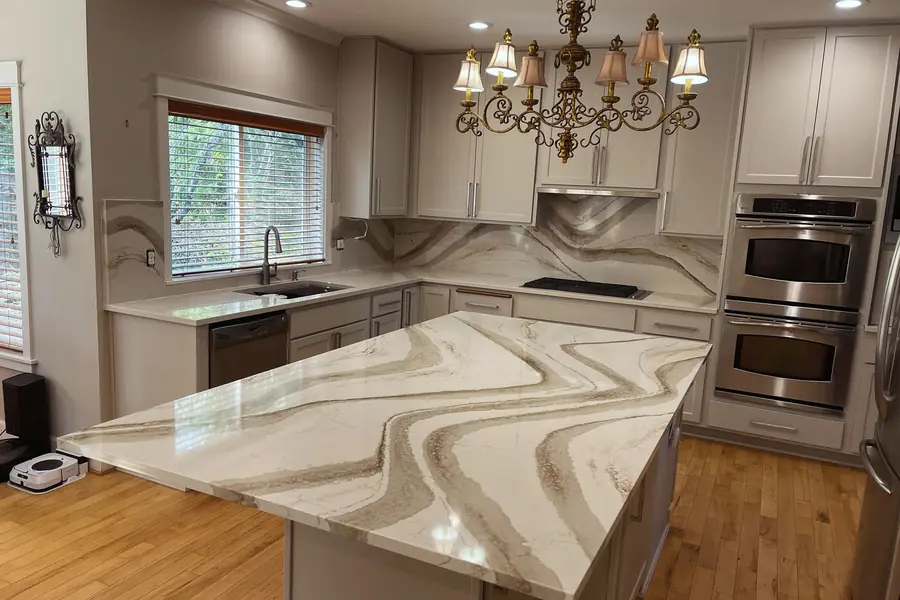
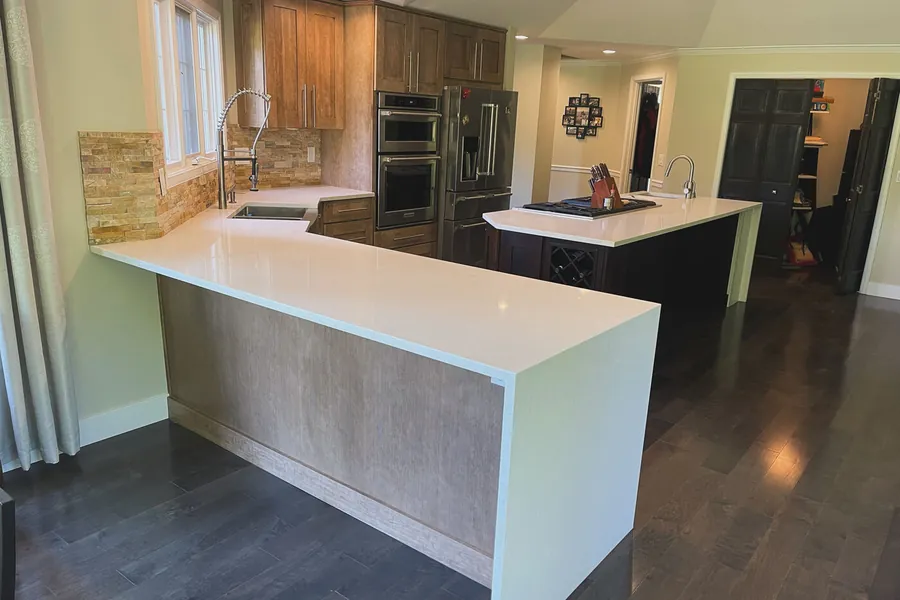
- Waterfall end on an island — the stone turns the corner and runs to the floor. Extra material, a mitered corner, a lot more polishing.
- Full-height backsplash — a second set of pieces, templated to the wall instead of to the cabinets, with the wall's own bows in it.
- Cooktop cutout — cut to the appliance specification and polished on the inside edge.
- Second sink or bar sink cutout — the same work again, on a smaller and more fragile piece.
- Mitered or built-up edge — two pieces glued and polished so the edge reads as thick stone.
- Ogee, bullnose and the shaped edges — machine time on the profile, then hand polishing.
- Drainboard grooves, curves and radius corners — same reason as the shaped edges.
- A seating overhang that needs support — steel or brackets under stone that hangs past the cabinet.
- Tearing out a tile counter — the tile, the mortar and usually the substrate come off together, and it takes longer than laminate.
- Stair carry, upper floor, no elevator — more people on the crew for the same day.
- Plumbing beyond a straight reconnect — new faucet holes, a moved disposal, new supply lines.
- Laying out an exotic or book-matched slab — the veining is arranged by hand so it carries across the seam, and the offcuts get bigger.
If your job needs none of these, none of these are on your quote.
How you get a real number for your kitchen
Countertop pricing stops being abstract the moment somebody stands in your kitchen with a tape measure.
Three steps, in this order. The order is the whole point.
- A free pre-measure, in person. Mike Barzul comes out himself, takes rough dimensions, looks at the cabinets and the access, and talks through what you want. No charge and no sales visit — nobody sits in your kitchen for three hours.
- A written quote, priced at the desk. He prices it afterwards, not standing in your kitchen with a clipboard, and it comes to you itemized by email within same day of the visit. Take it to two other shops and compare it line by line. We would rather you did.
- The laser template, once the price is agreed. This is the precise digital measurement your stone is cut from, and the specialist who takes it is paid by the square foot. We do not send him out on a maybe. Template happens after you have accepted the quote and your cabinets are in and level.
How you pay
Countertop pricing is only half the answer. Here is the money schedule.
A deposit when you approve the quote, and that deposit is what buys your slab. The balance when the counters are in, the seam is filled, and you have walked the job with us and said you are happy. Not before.
What the price includes after install day
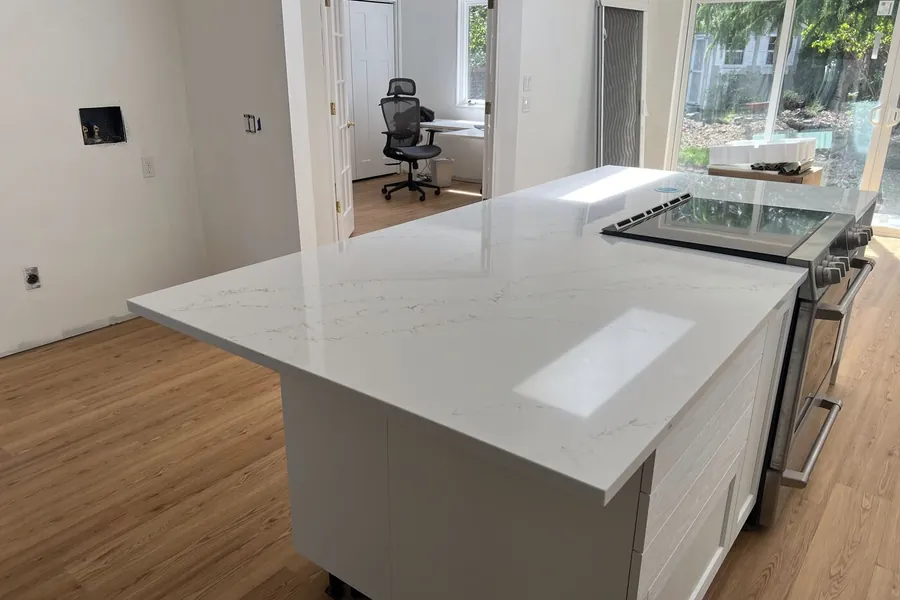
Every quote we write is backed by a one-year workmanship warranty on the installation — the seam, the fit, the edge, the sink attachment. It is not a line you pay extra for. The stone carries the manufacturer's own warranty separately, and that paperwork comes to you on install day.
Questions people ask about countertop pricing
What warranty do you give?
One year on our workmanship, counted from the day we install. That covers the things we control: the seam, the fit, the sink attachment, the edge, the level. The stone itself is a separate matter — it carries the manufacturer's own warranty, and that document goes to you on install day so it lives with your house papers.
Who has the best price on countertops?
Nobody is cheapest on every job, and the shop with the lowest rate per foot is usually the shop with the most lines left off. Get three written quotes, check that all three include tear-out, haul-away, cutouts and the edge, then compare the bottom line. A quote missing those looks lower and finishes higher.
How much should a new quartz countertop cost?
It depends on which tier your slab sits in and how many slabs your layout needs, which is why we give you a tier at the measure rather than a range on a web page. Quartz runs from $ to $$$, and the distance between those ends is wider than most people expect from one material. Published market averages, from named sources, are collected in our Seattle cost guide.
What is the average cost of quartz countertops per square foot?
An average is the wrong tool for this. It blends an entry white quartz with a designer book-matched slab and returns a figure that describes neither one. The two things that actually move your number are the tier and the number of slabs.
Which is more expensive, granite, quartz or marble?
Granite usually starts lowest, quartz sits in the middle, marble runs highest. But a plain marble undercuts a rare granite, so the name of the material is a weak signal. Read the tier instead of the name.
How much does it cost to replace bathroom countertops?
A vanity is small enough that a remnant piece usually covers it, and remnants are priced by the piece rather than by tier. Send us the width and the sink type and we can talk it through on the phone.
Who has the best deals on quartz countertops?
Ask any shop what is on its remnant rack and which slabs have been standing the longest. That is where a real discount lives, not in a seasonal sale. Ours is in the shop and you are welcome to walk it.
Next step
You know how the figure is built. The next question most people have is procedural: how many days without a kitchen, and who shuts the water off.
Read how the install works, day by day · See what drives cost in this market · Book a free measure
Call (206) 643-9354. If we miss you, leave a message — you get a call back the same business day.