
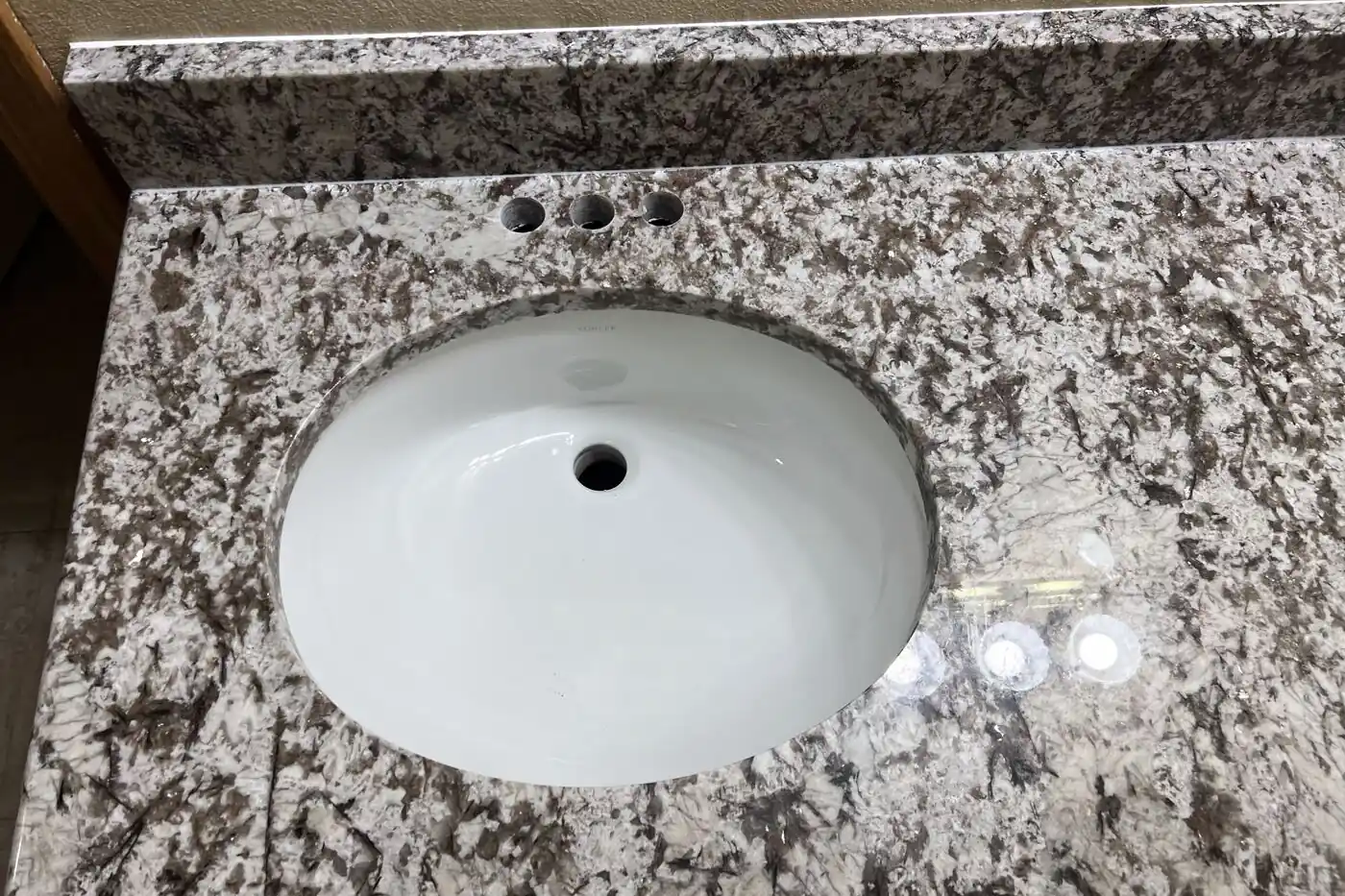
Short version: warm water, dish soap, a soft cloth. That is how to clean quartz countertops on a normal day, and it is all most kitchens ever need.
The rest of this page is the part nobody tells you at the showroom — what to keep away from the stone, how to lift a stain that has already set, what a chip actually costs to fix, and what our warranty covers.
Call about a repair · See our prices
How to clean quartz countertops, day to day
- Warm water, a squirt of dish soap, a soft cloth. Wipe, then dry it.
- Wipe spills when they happen, not at the end of the day. Wine, coffee, turmeric, beet juice and lemon are the ones that leave a mark if they sit.
- Use a cutting board. Quartz will blunt your knives long before your knives mark the quartz.
- Use trivets. A pan straight off the burner can leave a permanent dull ring.
That is the whole routine. No polish, no special spray, no monthly ritual.
What to keep away from quartz
| Keep away | What it does |
|---|---|
| Vinegar, lemon juice, citrus cleaners | Etches the resin that binds the quartz, leaving a dull patch |
| Bleach and oven cleaner | Discolors light-colored tops, often permanently |
| Abrasive powders and green scouring pads | Scratches the polish |
| Melamine foam pads | Same thing — they are fine abrasives, not sponges |
| Paint stripper, drain opener, nail polish remover | Strip the surface finish on contact |
| Hot pans set straight down | Thermal shock, dull rings, sometimes a crack |
| Standing water at the seam | Works into the filler over years |
What does vinegar do to quartz? Quartz is stone dust held together with resin. Vinegar is acid. It does not hurt the stone, it eats the resin between the grains, and what you get is a patch that has lost its shine and will not polish back with a cloth. The same is true of lemon, descaler and most bathroom sprays.
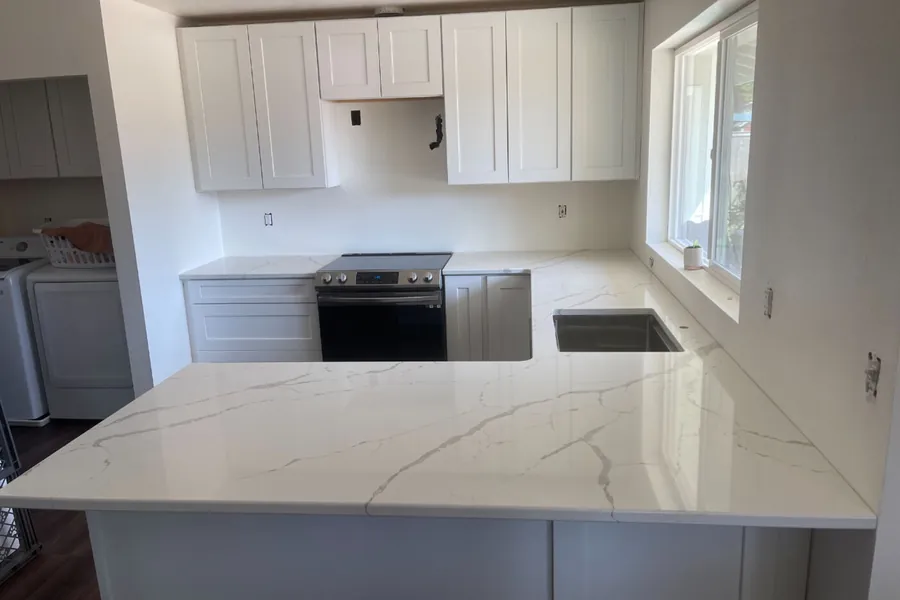
Granite, marble and quartzite are different
Quartz never needs sealing. Natural stone does.
Ignore the calendar. Use the water test. Every "reseal every N years" number you read online is a guess, because it depends on the density of your particular slab, the sealer that was used and how hard the kitchen gets worked. The stone will tell you itself:
Leave a tablespoon of water on the counter, next to the sink where it gets the most use. Come back in 15 minutes. If the stone under the puddle has gone dark, the sealer is worn through and it is time. If it is still the same colour, do nothing.
Do that test twice a year and you will never over-seal or under-seal.
- Granite — dense, and the water test usually stays dry for a long time. Test it, do not guess it.
- Marble — softer and acid-sensitive. Lemon, wine and vinegar will etch it, and sealing does not prevent etching — nothing does. Seal it against staining, and accept that a used marble counter looks used.
- Quartzite — harder than marble, still natural stone, still fails the water test eventually. Same test, same answer.
We reseal counters we did not install. It is a flat charge for a standard kitchen, quoted on the phone once you tell us the stone and the length of the run, and it is a short visit — the sealer has to sit on the stone and then be buffed off, not left overnight.
How to get a stain out
- Start gentle. Warm soapy water and a soft cloth, worked in circles.
- Grease and oil — a little degreasing dish soap left on it for a few minutes, then rinse.
- Dried-on food, wax, gum, paint drips — scrape it flat with a plastic scraper. Not a knife, not a razor held upright.
- A ring that will not come out of natural stone — a poultice. Baking soda and water into a paste, spread over the stain, plastic wrap on top, taped down, left overnight.
- Ink, dye or a mark that has soaked in — stop and call us before you try anything stronger. Most of the tops we see ruined were ruined by the second attempt, not the stain.

Chips, cracks and a seam that has opened
Chips happen at the sink cutout and along the front edge, usually from something dropped.
- Keep the piece if you find it. A chip with its own fragment glued back is close to invisible; a chip filled with color-matched resin is good but visible up close.
- A chip is a repair, not a replacement. One visit in most cases. Send a photo and we quote it before anyone drives out.
- A crack across a run usually means movement underneath — a cabinet that dropped, or a dishwasher that was pulled without support. We look before we quote.
- A seam that has opened or discolored can be routed out and refilled with fresh color-matched filler. Repairing granite countertop seams is one of the more common calls we get, and it does not require replacing the top.
We repair and polish counters that somebody else installed. No hard feelings, no questions about who did it. Call (206) 643-9354 with a photo and we will tell you if it is worth fixing.
What our warranty covers
Our workmanship warranty is one page long, in plain English. Read it before you sign, not after — ask us for it at the measure and it comes with your bid.
Covered: seams that open or lift, pieces that come loose from the cabinets, cutouts that were cut wrong, edge polishing that fails, caulk that fails in the first year, and anything we damaged in your home during install.
Not covered: heat marks from a hot pan, etching from acid cleaners, chips from impact, cracks caused by movement in the cabinets we did not build, and stone that was sealed by somebody else and left too long.
Warranty visits are free. We do not charge a call-out fee to come and look at our own work.
The manufacturer's warranty on the slab itself is a separate document and it comes from the manufacturer, not from us. Terms differ by brand — some quartz makers register the warranty to the homeowner and the address, some require the paperwork from the installer. Ask us for your slab's warranty document at install and keep it with the house papers. If you ever need to make a claim on it, we will hand over our part of the paperwork.
Questions we get after the install
What warranty do you give?
One year on our workmanship, counted from the day we install. That covers the things we control: the seam, the fit, the sink attachment, the edge, the level. The stone itself is a separate matter — it carries the manufacturer's own warranty, and that document goes to you on install day so it lives with your house papers.
What does vinegar do to quartz?
It dulls the resin between the stone grains. The mark does not wash off. Use dish soap.
What is the downside to quartz?
Heat. Quartz handles knives, water and daily wear better than natural stone, but a hot pan can leave a permanent dull ring, and no cleaner brings it back. Direct sun also fades some colors, which matters on a window run.
Do quartz countertops need sealing?
No. Sealing quartz countertops does nothing — the surface is already non-porous. Anyone selling you an annual seal on quartz is selling you a bottle of nothing.
Can you use disinfecting wipes on quartz?
Occasionally, yes. Daily, no. Most of them are mildly acidic, and daily use over years takes the shine off. Soap and water for the routine, wipes for the raw-chicken moment.
How do you repair a granite countertop seam?
We rout the old filler out, clean the joint, refill it with color-matched filler, then flatten and polish it. One visit, and you should not be able to feel it afterwards.
Do you polish countertops you did not install?
Yes. Polishing quartz countertops, granite and marble is a service on its own, priced by the size of the kitchen and by how deep the damage goes. Send a photo and you get the figure in writing before we come out.
Next step
If your counters are already in and something is wrong, send us a photo. If you are still choosing, the money question comes first.
How a countertop price is built here · How install day works · Call about a repair
Call (206) 643-9354, Monday–Saturday, 8:00 – 5:00. Leave a message and you get a call back the same business day.