
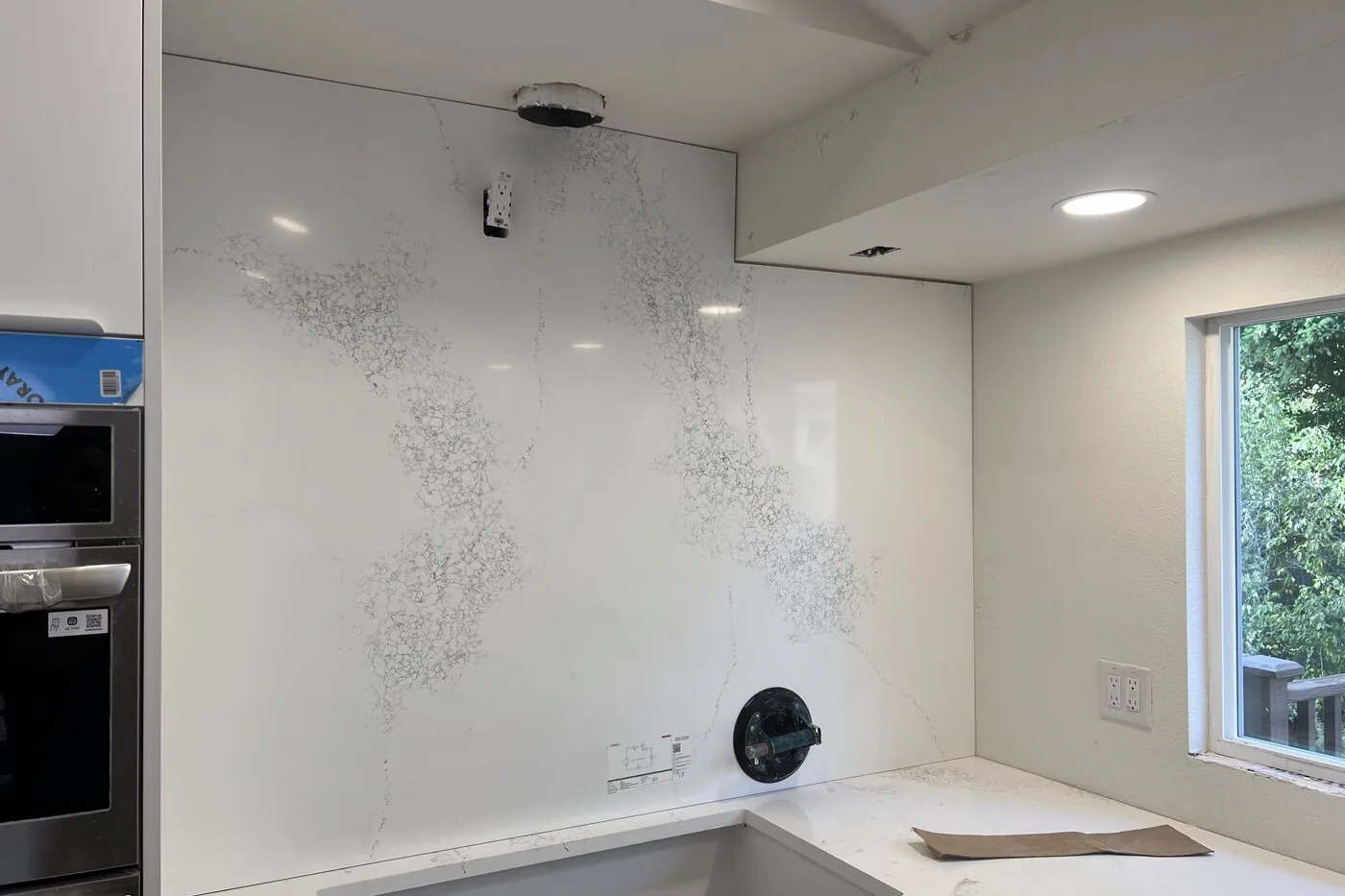
A seam exists because your kitchen is longer than a slab. A good one is 1/16 inch wide or less, dead flat to a fingernail, filled with color-matched adhesive, and placed where the pattern and the light hide it. You can demand all four of those. You cannot demand that it be invisible.
Why countertop seams are not optional
Slabs come in fixed sizes. Engineered quartz is pressed in a mold, most commonly 120 to 130 inches long by 55 to 65 inches wide. Natural stone is sawn from a quarry block, roughly 105 to 130 inches long by 60 to 78 inches wide. A kitchen counter is 25.5 inches deep, so a wall run of 12 feet is 144 inches, and no slab covers it in one piece.
Three other limits force a seam even when the run is short enough:
- Weight. A 3cm slab weighs about 18 pounds per square foot, so a single 10-foot piece runs close to 400 pounds. Stone is strong in compression and weak in tension, and a long piece carried flat can crack under its own weight before it reaches your kitchen.
- Doorways and corners. The piece has to come off the truck, through the door on edge, and around whatever your hallway does. Sometimes the geometry of your house makes the seam.
- Inside corners. An L cut from one piece leaves a sharp inside corner, and stress concentrates there. It is the most common place for a countertop to crack years later. Seaming at the corner instead is a structural decision, not a shortcut.
Anyone promising a seamless kitchen larger than a slab is counting on you not to check.
Where a seam has to go, and where it must not
Countertop seams get placed for three reasons: structure, slab size, and what your eye will forgive. Good shops weigh them in that order.
| Seam location | Verdict |
|---|---|
| Inside corner of an L or U layout | Correct. Relieves the stress point |
| A run longer than the slab | Forced. Ask where, not whether |
| Middle of a sink cutout | Acceptable, if both halves are rodded and the front bridge supported |
| An island longer than the slab | Forced. Centered reads better than off to one side |
| Directly over a dishwasher | Avoid. Steam cycles the joint and nothing supports it |
| Through a cooktop cutout | No. A narrow bridge plus repeated heat is how tops crack |
| Mid-run under a window | Avoid. Raking light finds every joint |
| Where an unsupported overhang begins | No. Support first, then seam |
Homeowners who find a seam through the middle of the sink cutout usually assume they were cheated. Usually not: the cutout removes most of the stone there, so the joint is short and largely hidden by the faucet deck and the rim.
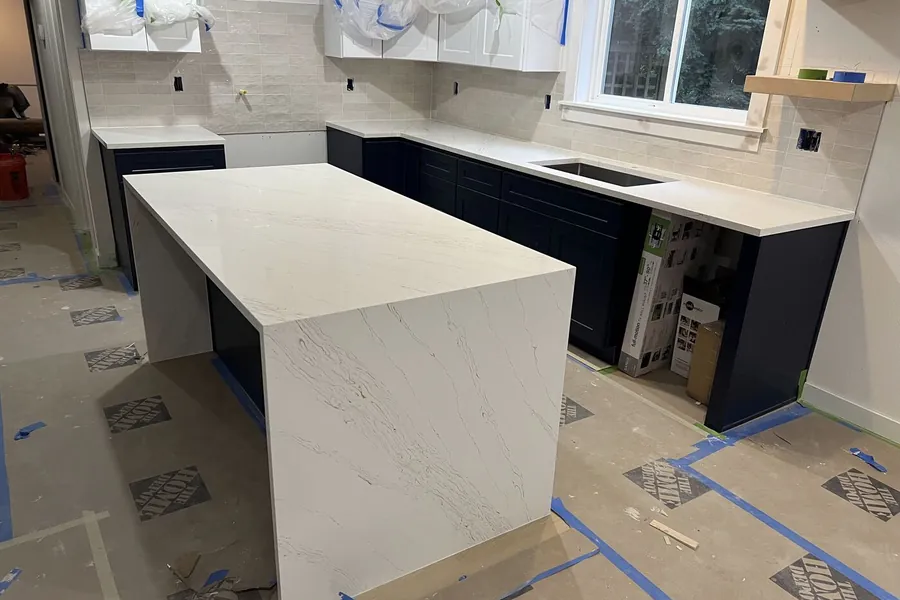
What a good seam looks like at counter height
Judge it standing up, from where you work. Not with your cheek on the counter.
- Width. The Natural Stone Institute, which publishes the industry's dimension stone standards, puts a residential seam at 1/16 inch or narrower. A 1/8 inch seam is double that, and it is the width homeowners photograph and post online.
- Flatness. Run a fingernail across it. You should feel nothing. A lip you can catch is called lippage. It collects grime and eventually fails.
- Fill. Two-part color-matched adhesive, tinted to the slab, scraped flush and polished. Not grout, not caulk, not clear epoxy that reads as a dark line.
- Pattern. On veined stone the vein carries across the joint. On a plain color there is nothing to align, so placement and light are all you have.
- Shadow. Two polished edges catch light differently. In raking side light you will find the line. In room light you should have to look for it.
The best description of a good seam we have read came from a homeowner, not a fabricator: the seam is so tight you cannot see any epoxy and it is nearly impossible to find.
What makes a seam bad
Homeowners describing a bad seam online are consistent, and they are usually right. The complaints repeat: the seam looks atrocious. It is 1/8 inch wide. It is not uniform. It is indented. It is in a weird spot. Every one of those is a real defect with a name:
- Too wide. Past 1/16 inch you have a gap being filled, not a joint being closed.
- Not level. One side sits proud of the other. Unshimmed cabinets are the usual cause, and the fix belongs before the stone goes down.
- Indented. Eased edges leave a valley that must be filled. Filled flush it is fine. Left low it collects everything.
- Wrong filler color. A dark line across a white top: thirty seconds of mixing that you look at for fifteen years.
- Two slabs that do not match. Not a seam problem, but discovered at the seam. Consecutive slabs from one block agree; slabs from two blocks do not.
- Placed with no discussion. The seam went where the yield was best and nobody showed you.
That last one is the complaint underneath most of the others. A professional on Houzz put it plainly to a homeowner mid-disaster: they should have had you sign off on the template, showing you where and how they were going to marry the two pieces.
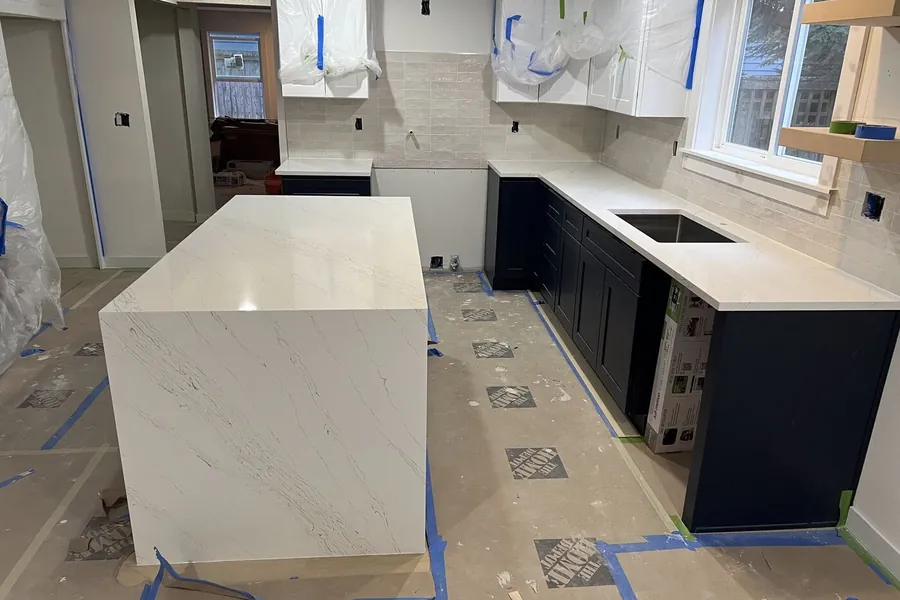
What you can reasonably demand, and what is impossible
Countertop seams sit on a line between workmanship, which you can insist on, and physics, which you cannot.
You can demand:
- A seam layout drawing after the template, showing where every piece breaks and how the vein runs, before anything is cut.
- A seam of 1/16 inch or less, flat to a fingernail.
- Filler tinted to your slab, scraped flush and polished.
- Consecutive slabs from one block when the job takes more than one.
- A walkthrough before final payment, with the balance held until the seam passes.
You cannot demand:
- An invisible seam in a solid or lightly veined color. The filler is opaque and the two polished edges reflect light differently. Physics, not effort.
- A single piece across a run longer than a slab.
- A vein matched across the joint at every point. It matches at the seam line. Two inches away it goes where the quarry sent it.
- A flat seam over cabinets that are out of level and were never shimmed.
If the counter is already in and you hate the seam
Four things, in this order, before anyone argues with you.
- Photograph it in daylight and again in side light, with a coin in the frame.
- Measure the gap and check level with a fingernail and a straight edge.
- Find your template sign-off. If nobody showed you where the seam would go, say so in writing.
- Hold the balance. Too wide, discolored or low is a rout-and-refill visit. In the wrong place is a remake.
Countertop seams are the one detail in this trade a homeowner sees every day, which is why they generate more rage online than price does. The seam is rarely the failure. Not being shown it in advance is.
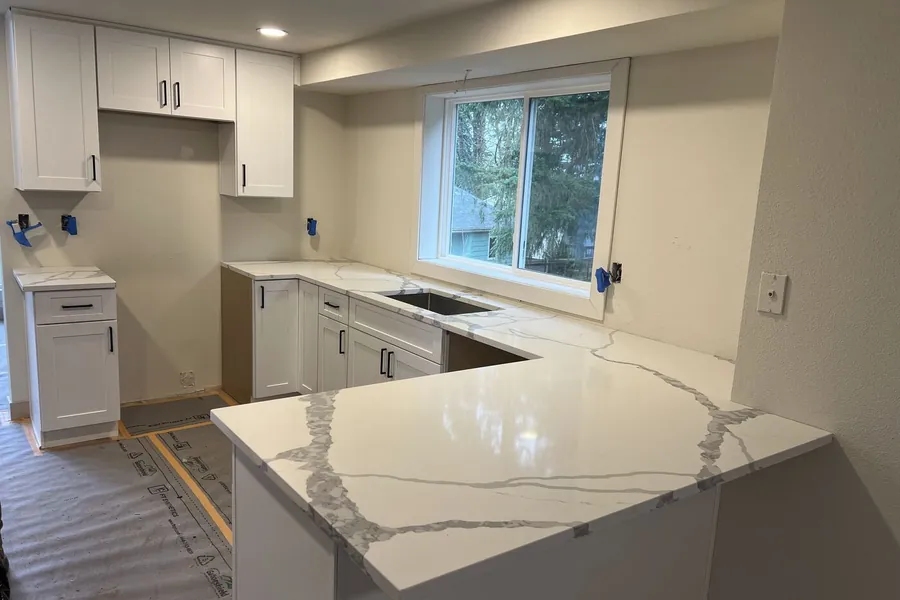
Questions people ask about countertop seams
Are seams in countertops noticeable?
Close up, in every material. Busy natural stone hides them best. A plain white engineered surface hides them worst.
How wide should a countertop seam be?
1/16 inch or less, per the Natural Stone Institute's dimension stone standards, and flat enough that a fingernail crosses it without catching.
Are seams in quartz countertops always visible?
Effectively yes, up close. Quartz has no natural movement to break up the line and the adhesive is opaque. Placement and lighting decide how often you notice it.
Why is there a seam in the middle of my sink?
The run is longer than the slab, and the cutout is the least conspicuous place to break it. Both halves should be reinforced and the front bridge carried by the cabinet.
Can a bad countertop seam be fixed?
Too wide, discolored or slightly low can be routed out and refilled in one visit. Not level, or in the wrong place, is a remake.
Can you hide seams in quartz countertops completely?
No. You can place them where light and layout work against noticing, match the filler and set them flat. Invisible is not something the material does.
Do countertop seams ever fail?
They open when cabinets move, when the joint was never flat, or when standing water works into the filler over years. A flat seam on level cabinets outlasts the kitchen.
What to do next
Seams behave differently in every material, and quartz is where they show the most.
How seams work in quartz, and what the stone costs installed