
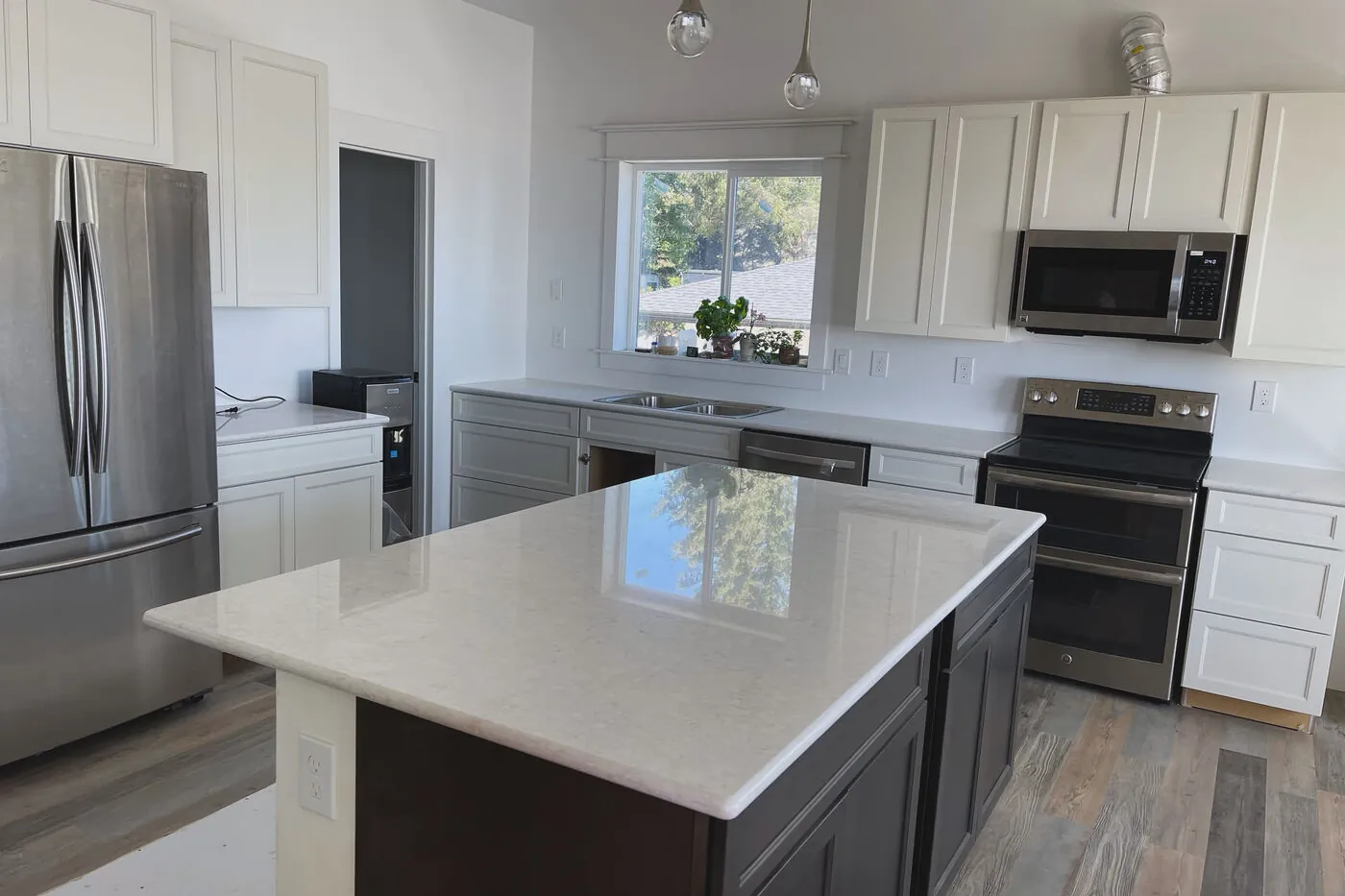
Answer five questions and the choice makes itself: what happens on this counter, how much maintenance you will genuinely do, whether you want the surface calm or busy, how long you are staying, and what the number is. Most kitchens land on quartz or granite. The interesting cases do not.
Most guides on how to choose countertop material list ten surfaces, describe each one warmly, and refuse to pick. This one picks.
The seven surfaces, compared
| Material | Hardness | Hot pan | Sealing | Lemon and wine | Fixable on site | Price band |
|---|---|---|---|---|---|---|
| Quartz (engineered) | Mohs 7 mineral, soft resin binder | No, makers cap it near 150 °F | Never | Resists. Harsh cleaners dull it | Filled, visible up close | Mid to high |
| Granite | Mohs 6 – 7 | Yes | About once a year | Resists. Acid strips sealer | Yes, polished back | Low to high |
| Quartzite | Mohs 7, hardest we cut | Yes | About once a year | Resists if it is truly quartzite | Yes | Highest |
| Marble | Mohs 3 – 4 | Yes | More often than granite | Etches. Guaranteed | Yes, honed back | Mid to high |
| Porcelain / sintered | About Mohs 7 | Yes | Never | Resists | Edge chips are hard to fix | Mid to high |
| Butcher block | Soft, dents | No | Oil monthly | Stains | Yes, sand and re-oil | Low |
| Laminate | Soft, scratches | No | Never | Resists, but the seam swells | No | Lowest |
Two facts worth carrying out of that table. Everything hard enough to ignore your knives is also hard enough to blunt them, so you need a cutting board regardless. And the surfaces that can be brought back to new without leaving your kitchen are the natural stones and wood. Engineered quartz gets filled, not healed.
How to choose countertop material in five questions
1. What actually happens on this counter
Be specific and unflattering about it. Do pans come off a gas burner and go straight down? Is there a lemon on the counter most days? Does a toddler eat there? Heat rules out quartz, laminate and wood. Daily acid rules out marble unless you want the patina. Kids and no time rules out anything that needs sealing.
2. How much maintenance will you honestly do
Not aspirationally. A sealed stone wants a bottle, a cloth and twenty minutes once a year, and plenty of people never get around to it. If that is you, say so out loud and buy quartz. It is a scheduling fact about your life, not a character flaw.
3. Calm or busy
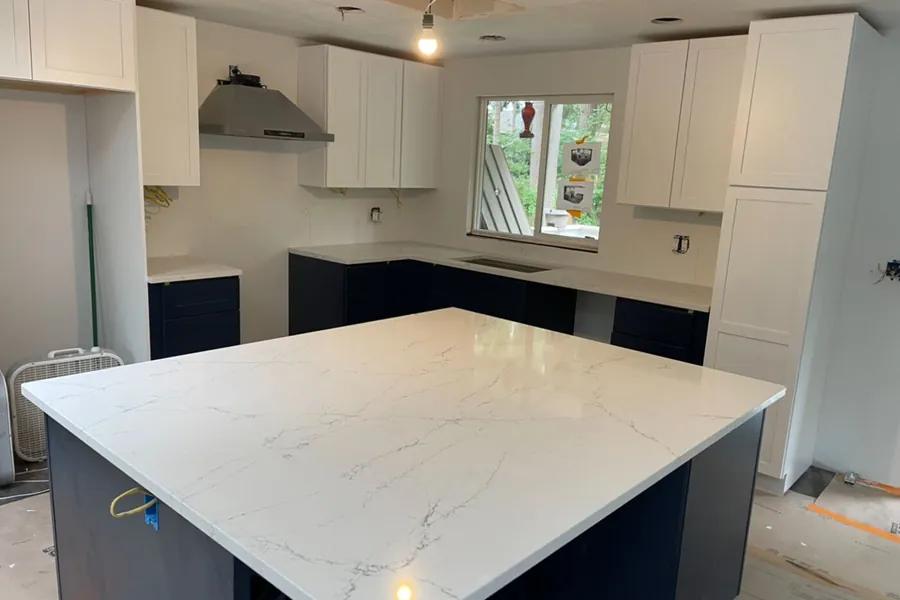
This decides more than looks. Movement in a slab is what a seam hides behind. A plain white surface is the hardest place to hide a joint, and every kitchen longer than a slab has one. Pick the calm surface if you want it, and then pick the seam location deliberately.
4. How long are you staying
Five years or fewer and the surface is a sales feature: even, light, low-maintenance, reads as new. Fifteen years and it is your surface, so buy the thing you will still like in a kitchen you have cooked ten thousand meals in.
5. What is the number
Ask for the installed price per square foot, not the slab price, and ask how many slabs your layout takes. Slabs are sold whole. A long island can force a second one, and you pay for the stone whether it ends up in your kitchen or on the offcut rack.
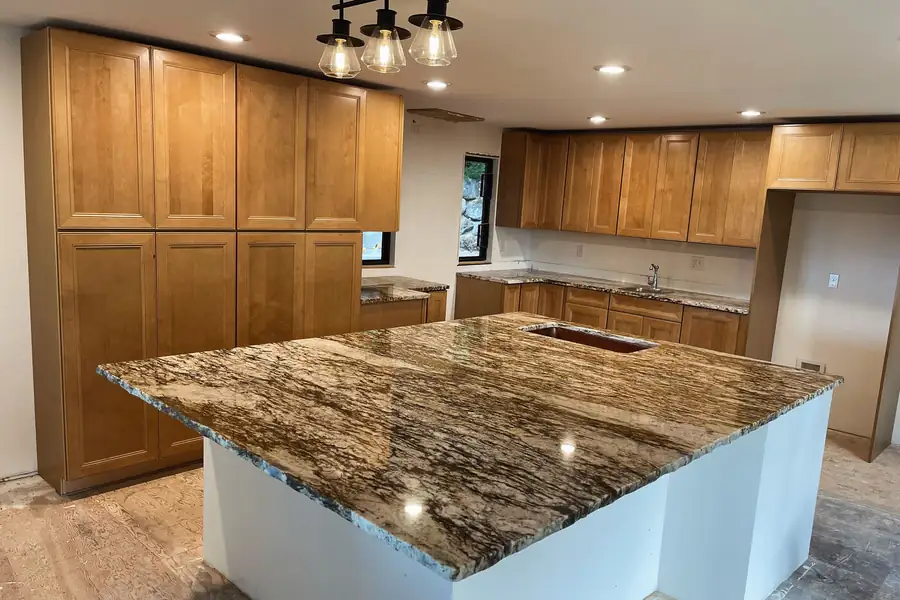
The pick, by household
| Your situation | Buy | What you are accepting |
|---|---|---|
| Two kids, weeknight cooking, no maintenance appetite | Quartz | Trivets forever, and a seam that shows |
| Serious cook, gas, cast iron | Granite or quartzite | Sealing once a year, and a slab you choose in person |
| Serious baker who wants a cold surface for pastry | Marble, honed | It will etch and stain, and that is the deal |
| Bathroom vanity | A remnant of anything | Very little. No hot pans, low traffic |
| Outdoor kitchen or covered patio | Granite or porcelain | Quartz is out. Sun yellows the resin and voids the warranty |
| Rental or a flip | Entry-group quartz or laminate | It is a rental. Buy the thing that photographs evenly |
| High-end kitchen where the island is the room | Quartzite or figured granite | The highest price per foot, and a wait while a slab is found |
| Budget is fixed and small | Common granite, or a quartz remnant | Your color choice narrows to what is in the yard |
The baker deserves a longer answer, because it is the one case where the trade is real. Marble stays cold, and rolling pastry on it is a genuinely different experience with no substitute. It will also etch where the lemon lands and stain where the oil sits. A homeowner in a thread full of marble regret put the frame that resolves it: it is a table, and it is supposed to be eaten on. Buy marble if that reads as reassuring rather than alarming.
The mistakes that cost the most
- Choosing from a four-inch sample. A chip tells you the color and lies about the movement. For any natural stone, stand in front of the actual slab with tape marking your island.
- Not asking where the seam goes. The most common regret in this trade is not the material. It is a seam nobody discussed until install day.
- Two slabs from two blocks. If the kitchen takes more than one slab of natural stone, they have to be consecutive slabs from the same block or the color will not match.
- Forgetting thickness. 3cm sits straight on cabinets and carries an undermount sink. 2cm is for vanities, or for a mitered edge built up to look thicker.
- Comparing bids that include different things. One bid with tear-out, haul-away, cutouts and edge is not the same document as one without. Make all of them itemized before you compare.
Questions people ask
What is the best quality countertop?
By hardness and heat tolerance together, quartzite. By everyday forgiveness, quartz. There is no single winner, which is why the table above sorts by what you do rather than by what is best.
What kind of countertops are popular right now?
Light quartz with soft veining is the volume seller. Quartzite has taken the top of the market from marble, and honed and leathered finishes have taken share from high polish.
What is the most durable countertop material?
Quartzite and porcelain, with quartz close behind on everything except heat. Durability splits into scratching, staining, heat and chipping, and no surface wins all four.
What countertop material is easiest to maintain?
Quartz. Soap, water, cloth, no sealing, ever. Keep vinegar, lemon and bleach away from it and it asks nothing else of you.
What are the different types of countertops?
Engineered quartz, granite, quartzite, marble, porcelain or sintered stone, solid surface, butcher block, laminate, concrete and stainless. The first five cover the large majority of kitchens built here.
How thick should a kitchen countertop be?
3cm is standard in a kitchen. 2cm is standard on a vanity, and is used in kitchens only when it is mitered into a thicker-looking edge.
Which countertop adds the most resale value?
Any real stone or engineered stone reads as an upgrade against laminate. None of them return their full cost, so choose for the years you will live with it.
What to do next
You have narrowed it to one or two materials. The next thing that changes your mind is the price per square foot with the cutting, the edge and the install already inside it.